
Shameful and non-shameful use of AI

I don’t use AI when translating documents for clients, for the simply reason that I don’t need AI to translate, I don’t like the translations it produces, and I’m the translator I present to my client as the person who cares about and will execute the translations of their documents. Using AI would be a betrayal.

Translation-brokering agencies, which are well along in their replacement of human professionals with AI—and that leaves former translators with only extremely low-paid and mind-numbing post-editing work—are in a different situation.

The reason is simple. Almost all translation that is paid for by translation consumers is done by entities that are not themselves involved in executing translations, beyond purchasing the translations and then, if necessary, purchasing editing thereof before selling them. That is the case now, and it has been the case for many years, from long before humans found themselves being replaced by AI. Since entities that sell translation are only very rarely involved in doing translations, it makes sense for them to move away from expensive human professionals, and they are succeeding in that move.
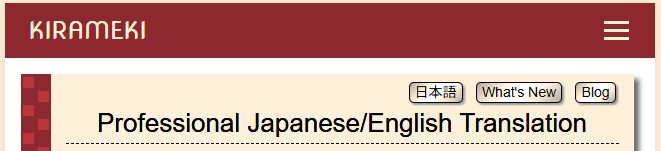
Top Page of my company website

That said, for a process or task that I do not purport to do myself or sell to clients as a practitioner, I am more willing to use AI. If you look in the upper-right corner of my company website pages, you will see a hamburger menu icon. I have manually written the HTML for my considerable number of webpages for many years, resisting adding such a feature, not understanding how to do it, either with or without JavaScript. I gave in the other day and used Claude.ai to build that feature into my website. It took less than three minutes to obtain the required patch of html markup and the associated JavaScript, required no cash outlay, and it gave me what I needed with just a plain-language prompt of about three lines describing what I wanted.

There is a putative environmental impact—it is much smaller, of course, than the impact resulting from building a fake video of a deceased celebrity or a dancing cat—but I am not at all ashamed I did that. That would not be the case if I were in the business of selling webpage designs.

Returning to translation, the translations I do are mine and will continue that way, as I continue to resist the mindless rush into a world where translators surrender to AI-using brokers and professionals of all sorts outsource not only their writing but also their thinking to a collection of software commands. That’s not my style, and I cannot see that changing anytime soon.

Entitlement and Linguistic Imperialism of Foreigners Wanting to Come to Japan

My recent participation on LinkedIn provided me a glimpse into how some foreigners—particularly foreigners who are having language-related employment problems in Japan or who want to come here to work but haven’t yet made it—view Japan and its “language problem.”

A complaint I often hear is that it is unfair for Japanese companies to require foreign employees to be Japanese capable. Some foreigners cite the requirement to pass a Japanese language proficiency test as being discriminatory. After all, they are highly educated, speak English, and have extremely valuable technical skills that don’t require Japanese ability, right?

I am not talking about farm or factory workers brokered into Japan from Asia, but rather people seeking work in jobs that call for a high level of education and skill; jobs such as programmer, but physically in a Japanese company, not on a farm in Tochigi or a factory in Aichi.

To my ears, the above type of comment is evidence of both entitlement and linguistic imperialism.

Where did these people get the notion that Japanese companies are obligated to treat them any differently from other employees?

I have spent a few years in Japan (about 50, actually), have had professional interaction with hundreds of companies, and have yet to encounter a Japanese company that operates in English here, or that would consider a foreign employee in Japan incapable of communicating in Japanese to be a full member of their team.

Surprise! The language of Japan is Japanese, and almost everybody here, including me, thinks that’s just fine.

The people voicing displeasure at the language requirement would, as employees, be required to interact on a daily basis with Japanese employees, most of whom are not proficient in English, and that needs to be done in Japanese. Interacting with other employees is part of the job. Without Japanese, a foreigner will not be fully functional.

These disgruntled foreigners need to remember that Japanese companies are made not of computer programs, databases, and hardware, but of carbon-based humans who communicate in Japanese. I suppose an argument could be made that the foreigners could work remotely, but then they don’t need to be in Japan, and that would burst the come-to-Japan balloon that many of these people are floating.

Why don’t Japanese speak English, some might wonder? Well, the short answer is that they don’t need to.

Additionally, although Japan never succeeded at conquering enough countries for long enough to force their language down the throats of many non-Japanese in a lasting manner, the situation with English is quite different. The success of anglophone incursions into countries and linguistic lives all over the globe has fostered a cohort of native English speakers who think that English is a given.

Maybe they think that having to learn Japanese places them at an unfair disadvantage with respect to native Japanese speakers. Fair or not, they are correct about the disadvantage and just need to suck it up.