Hardware I Have KnownVarious and sundry hardware—mostly electronic—that I have owned and/or used over the years
Here are just a few stopping points on my hardware memory lane, starting back in the 1950s and running up until the point at which most hardware morphed into commodities made in a country that does not share the same values as the countries that use the hardware. As time permits, I will be adding more items.
National Radio NC-98 Communications ReceiverAcquired and used from c. 1955 until around 1958
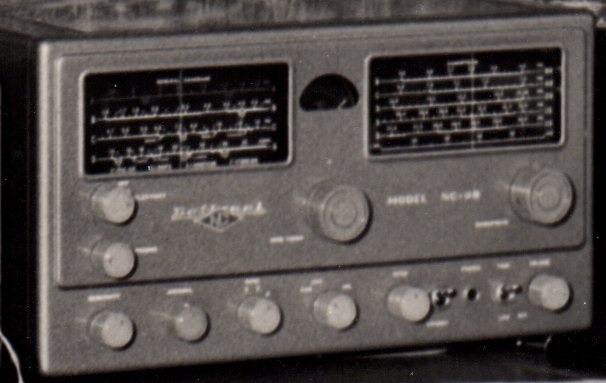 I got my first amateur radio license when I was 10 years old, in 1955. This photo is from a larger photo of my ham shack, taken around 1955. The NC-98, coupled with a Globe Chief transmitter, was my first receiver and transmitter, which served me well during my year with a Novice amateur radio license. The NC-98 had what were referred to as slide rule frequency scales, with cursors driven by strings attached to round tuning knobs.
No matter how many years have past since owning this receiver, it still has an aura that cannot be matched by much more sophisticated receivers I subsequently used, including the R390 I used in the Navy.
J-38 Telegraph KeyAcquired and used from c. 1955 until around 1957
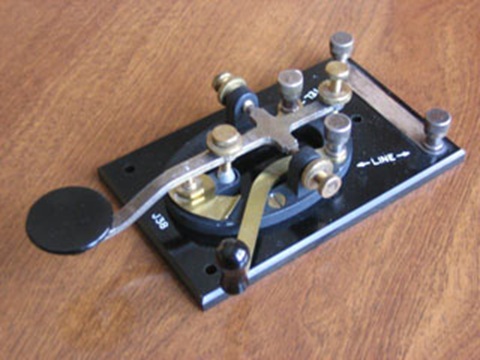 This is the first telegraph key I used as an amateur radio operator, starting when I was in the fourth grade in New York. At the time, these were plentiful on Canal Street in Manhattan, which was lined with shops selling all varieties of WW2 electronic surplus equipment.
After a few years using this "straight key," I graduated to a Vibroplex bug that used a flexing element that vibrated to make Morse code dots, thereby eliminating the need to make dots individually, since all you needed to do was press the paddle to the right and release with a timing that allowed it to vibrate just the right number of times for the number of dots you wanted to send.
Vibroplex BugAcquired and used from c. 1957 until around 1967
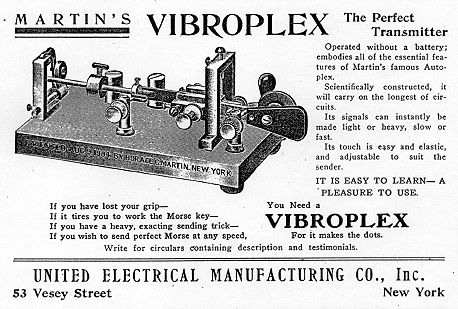 Early in the 20th century—the ad you see appeared in 1906—a telegraph key was developed that made it easier to send a series of dots. The Vibroplex bug brought that innovation and is still available, priced at a bit over USD 300. Dots were made by pushing the red paddle to the right and allowing the spring mechanism to oscillate a contact to generate the desired number of dots. Dashes were made more conventionally, but pushing the shorter, right-side paddle to the left.
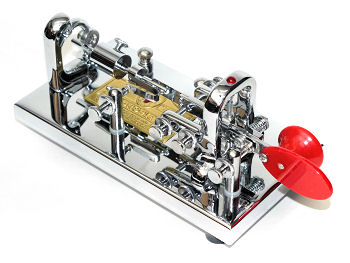 My version was the Deluxe, which many amateur radio operators active those days will surely remember. I had that bug at least up until around 1967, when I was learning Russia at Defense Language Institute. The base permitted me to set up a radio shack in an unused building. It has long since gone absent without leave, and I suspect I left it in New Rochelle after I discharged from the USN.
Hemmi Model 32 Slide RuleAcquired in early 1970s; still in my collection
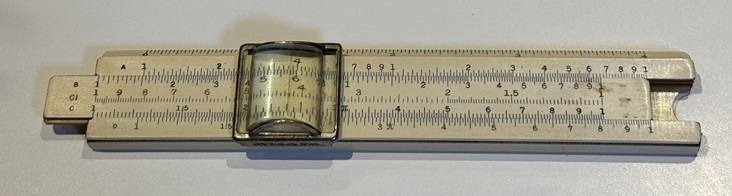 Slide rules ruled until their sudden demise in the mid-1970s in Japan and somewhat earlier outside of Japan. I acquired this modelwhen I moved to Japan this time. It is still in my collection of about 50 specimens. I once owned about 450 slide rules, but I pared them down to the 50 or so I "really needed" when I moved from Tokyo to Yokohama. Because slide rules disappeared somewhat late in Japan and because stationery stores tend to keep old stock around for a long time, as of just several years ago, you could find slide rules in old stationery shops here in Japan.
Teletype Corporation Model 33 (ASR33)Observed in the USN in the 1960s; had in my office in Japan c. 1976
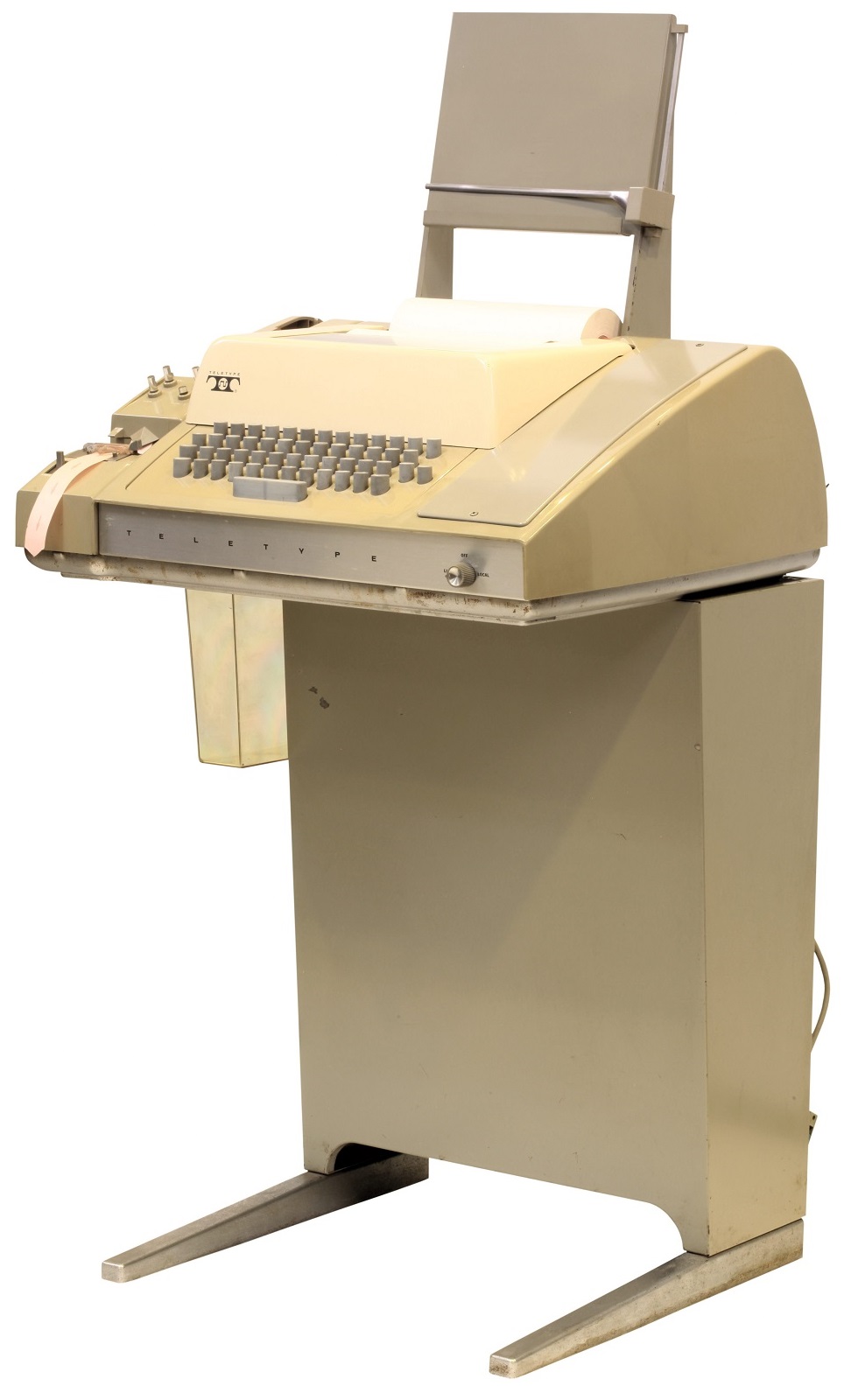 When I was working at Western Electric's Engineering Research Center in Princeton, NJ, the ASR33 Teletype terminal was our workhorse computer output device. We also had a storage-screen terminal made by Tektronix, the oscilloscope manufacturer, but this was our main output device. The ASR33 was painfully slow by today's standards, but was used by some to play computer games. One was a Startrek game that, after you fired a weapon, painfully printed out the next situation as you waited while the terminal clickety-clacked away. For communicating with people in other Bell System laboratories, we had an acoustic coupler, onto which we rested an analog telephone headset. The ASR33 was used on a daily basis to communicate with the DEC PDP10 timesharing system in the computer room. If you needed to use the IBM 360 in that same room, the output printer would be either a huge line printer or a Selectric typewriter output device.
Nikon 50mm/F1.4 LensAcquired in 2001 and still own.
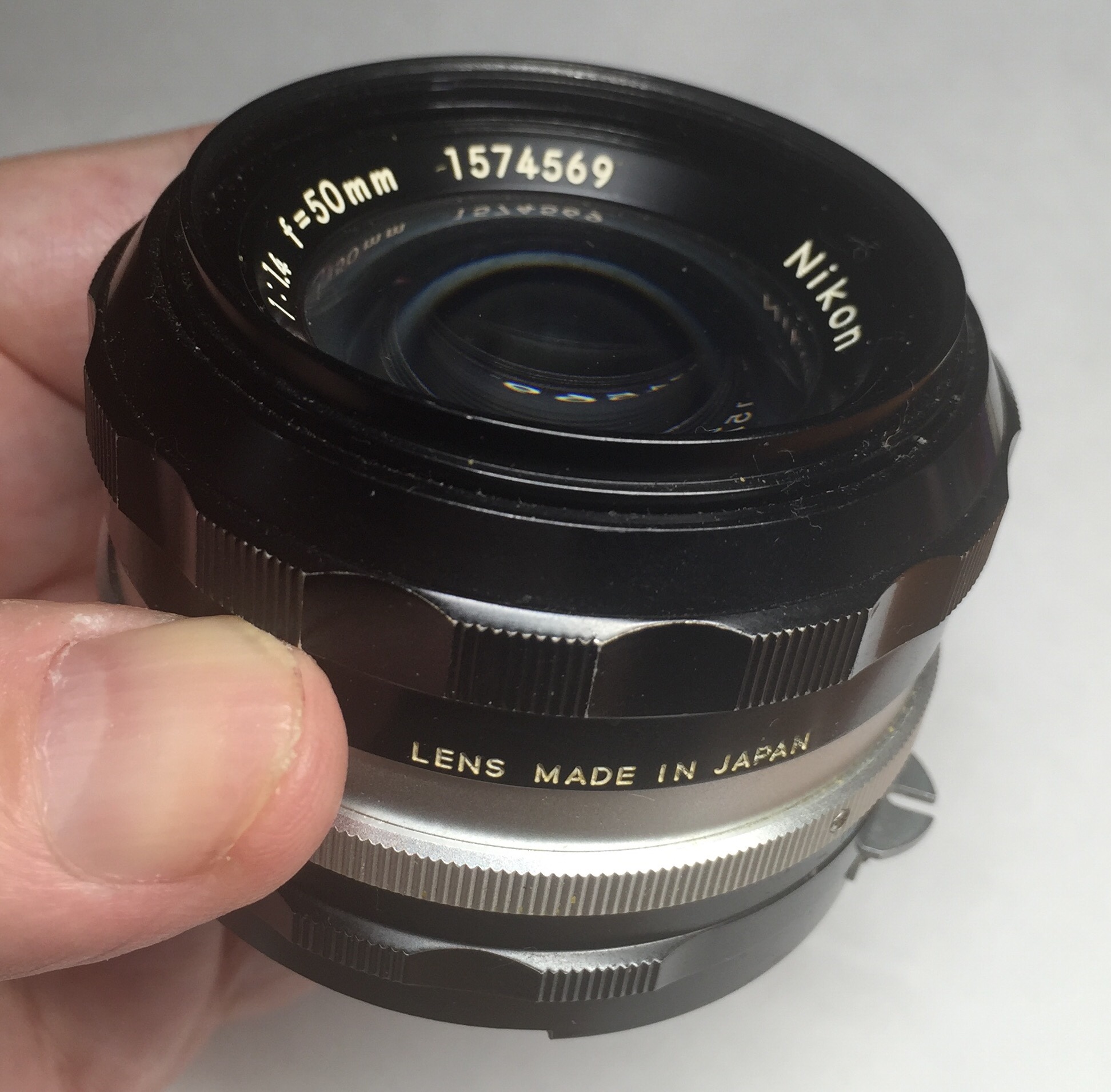 This lens was manufactured before the Ai series of lenses appeared. I purchased it in Osaka one time while on an interpreting assignment and had it modified to fit on the Nikon D810 I had at the time. It is super heavy and has that wondrous heavy feel of lenses from the days when men were men and lenses were lenses.
These days, Nikon lenses are mostly made in Vietnam or China. They are much lighter, of course, and on a light body a lens like the one shown here would not be a good match in terms of balance. For the heavier, up-market models, however, these old lenses, performance aside, are not a problem.
Vacuum Tube R390A Communications ReceiverUsed in USN 1967-1969
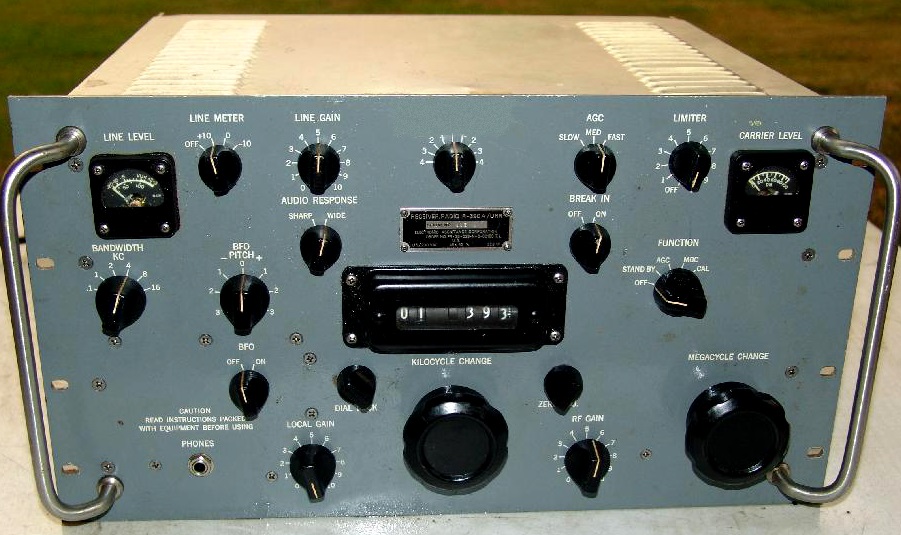 This was one of the receivers I used in the USN during the 1960s, when I was listening to enemy communications (hint: I was a Russian linguist).
The inside of the R390A was a wonderland of gears, and coils with slug cores that were moved up and down therein by rods a complex cam and gear mechanism..
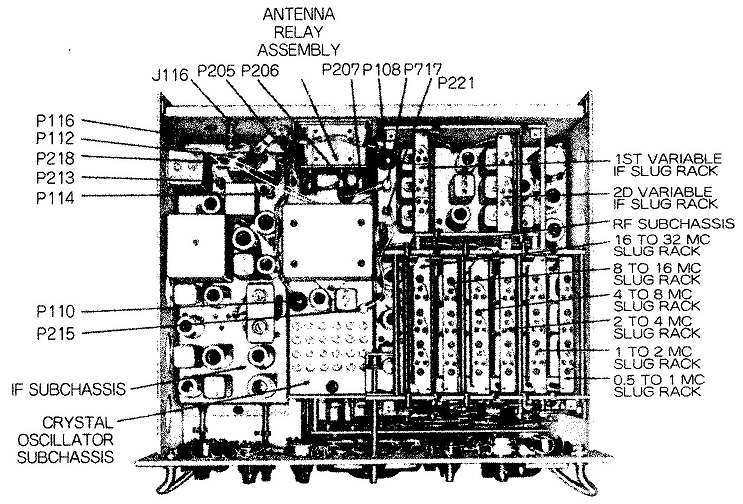
R390A Inside Top View
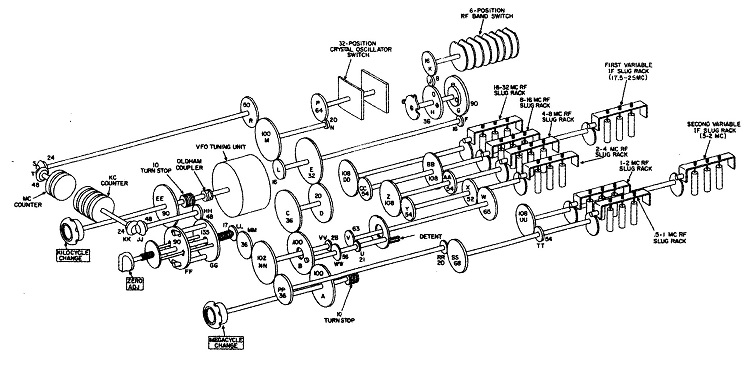
R390A Tuning Mechanism
The R-390A was extremely heavy. I cannot provide a precise weight, but I can attest to the weight from my experience. One time in the Indian Ocean (on the John R. Perry, DE1034), we took a serious roll to port (that's left for you landlubbers). Facing starboard, and in front of my R390A, which was mounted in a 19-inch rack, I instinctively (but stupidly) grabbed onto the rack handles to avoid falling over backwards. What I did, however, was pull the receiver out of the rack onto me, evidently stripping the threads in the rack. The resulting scene, with me on the deck, flailing my arms and legs with the R-390A on my chest like a wounded insect, was something to see. Because it was the midwatch, with nobody around, I escaped the laughter of my spook colleagues.
Coming Soon
- Tektronix 4016 Terminal
- Globe Chief Amateur Radio Transmitter
- W9TO Keyer
- Olivetti Russian Typewriter
- PC-98
- Selectric Typewriter
- Simpson 260 Multimeter
- Nishikigoi Cellphone
- 8-Inch Floppy Disks
- Apple Quadra
- Xerox J-Star Workstation